- Fool of Swords Newsletter
- Posts
- Two Ways To Teach
Two Ways To Teach
How We Run Practices/Classes

Arik Mendelevitz
March 03, 2026
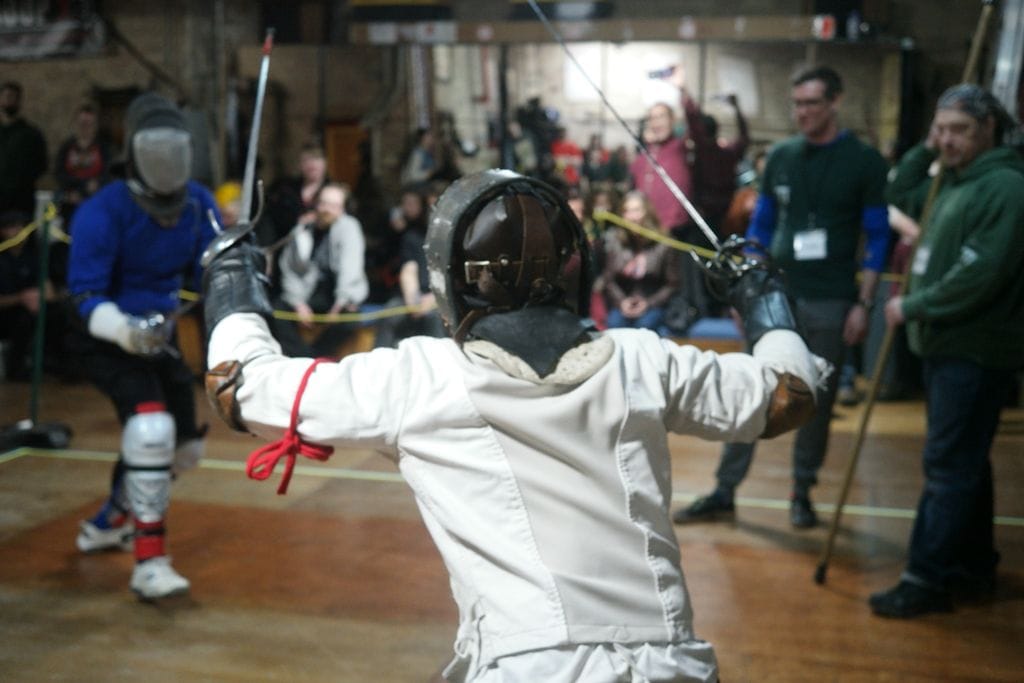
As of this month, my rapier career is officially old enough to vote. In celebration, I wanted to share with you an article that I’ve been meaning to write for years. Throughout my years, I’ve had the distinct pleasure of training with all sorts of groups across the SCA, HEMA, and all sorts of other martial arts. In that time, I’ve noticed two major approaches to how practices/classes are structured. I’m going to generalize a bit here, so if your group doesn’t fit neatly into just one or the other, that’s perfectly fine and I’m not trying to exclude what you do. Instead, my aim here to provide our community with language do better describe what’s already happening in order to deepen our conversations and help people make more active choices about how they want to learn.
Dojo Model
If you’ve ever done any non-sword based martial arts, or any fitness classes, this will seem like the norm to you. In short, this model has one teacher leading the class, maybe with a senior student or two helping out as well. You then line up all the students, having them either repeat a set of techniques on their own or in pairs. Everyone work on essentially the same thing at the same time. Maybe the instructor has a more advanced variation in their back pocket or has the folks just starting off split off in order to work on the “basics” for a few sessions before they’re fully ready to join the rest of the group. Either the head instructor will decide what everyone’s working on that day, or there will be some sort of larger syllabus in place that students can follow in a predictable fashion. The second one could look like having a set of topics that rotates through every three months, or it could just be, “We’re doing voids this week.”
Overall, the dojo model employs a very top-down framework where the work of deciding what to work on is on the shoulders of the instructor and the students just need to worry about executing the technique/drill/game that they’re given. If a group using the dojo model has a ranking system, there’s typically a very clearly delineated set of requirements to move from one rank to the next. This could be number of hours, memorizing solo forms, writing a paper, performing a set of techniques “correctly”, etc.
This way of teaching seems to largely emerge around the late 19th /early 20th centuries. We can see this, for instance, with the Chinese Jing Wu Athletic Association being established in 1909. While not particularly relevant to the plot, this is the backdrop for the Bruce Lee movie Fist of Fury. Around this time we see formal martial arts training shift from being family based or having a patron sponsor a master to come and teach at their court, to instead being publicly held classes aimed at a rising middle class. It’s no coincidence that this top-down approach to teaching the public how to fight happens around the same time as a rise in professional, standing armies across the globe. At the same time (1907) we see Jigoro Kano, the inventor of judo, create the modern belt system having students start off with white belts and moving up to black, that has now become the norm in martial arts training across disciplines.[1]
Salle Model
Instead of being focused on classroom management, teachers in the salle model tend to focus instead on one-on-one coaching. Depending on whether your group has their own permanent space as well as how often classes/practices are run, there’s a few ways this tends to play out. One version of this is that you have a time set every week for open floor where students can get some free sparring in, with the rest of the time slots being students texting instructors and junior instructors to see when they’re free to work one-on-one. Another version is to have everything happen at the same time. With this you can have an open floor where students can work with each other or approach the various instructors with something they want to work on to improve their own game.
This more multipolar approach works best when there’s multiple qualified teachers in the room. It also recognizes the fact that sometimes it’s easier for a junior instructor to relate to a student than it is for a senior instructor who at this point doesn’t remember what it’s like to be just starting off. As a whole, the salle model is also much more “choose your own adventure” with the onus largely being on the students to figure out what it is they want help with instead of following along with a premade class and trying to figure out how to slot their needs in to that larger framework. The danger here is that it’s far too easy for a salle style practice to default to an approach of “the squeaky wheel gets the grease” with those being the most vocal about their learning journeys receiving the most attention. At the same time, it leaves room for students who don’t click with the head instructor to find someone they learn better from without having to switch schools.
Historically, this is how a lot of more Western martial arts have been taught. Even today in modern Olympic fencing (MOF), the intro classes are done largely in accordance with a dojo model of teaching, but the more invested you get, the more things pivot over to a salle model. I’ve also seen the same thing happen with Muay Thai, with a lot of it being private one-on-one’s, and with judo where the advanced students are all on the mat at the same time but are largely left to their own devices to work on whatever it is they see fit.
Which One Should My Group Use?
There’s no one right answer here. It really comes down to the resources you have available, what everyone’s goals are, and what kind of culture your members are drawn to. If people are showing up to your practice in order to work out in a way that’s more fun than being stuck on a 19th century British torture machine[2], then a dojo model is probably best for what you’re looking for. Are the people at your practice more interested in tournament success? If that’s the case, the salle model is likely going to be a better bet if what you’re looking to produce are the best of the best. Dojo style teaching tends to have an averaging effect where no one gets left behind, but at the price of your top performers not getting the attention they might need to bring them to the next level. At the same time, if what you’re looking for is to create a unified atmosphere, it can be incredibly easy for a salle style practice to end up feeling cliquish with some folks gravitating to one or two instructors and other folks in the same room gravitating to somebody else.
Are the people coming in your door looking to be able to turn their minds off from work and just put in the reps? Then the dojo system might be exactly what you’re looking for. On the other hand, if what you’ve got is a passionate group of learners who all want to dive deep into the parts of the art they each find most interesting, then big group classes might be at odds with what people are really looking for. Maybe you have one person who moved to town recently who’s got years of experience and accreditations, but everyone else is just starting off. In that case, a salle style practice might be hard to implement. If, however, you’ve got a bunch of talented, hungry, up and comers; then having them do the same reps as everyone else might stifle their joy and lead them to break off and start up their own groups instead of helping grow something larger.
These two approaches aren’t mutually exclusive, but they can be very distinct. Maybe you choose to run the beginners classes under a dojo model and open things up in to a salle model for the more advanced students. Instead you might have a salle style practice lacking in cohesion and bring in a bit of dojo style thinking by having everyone do a big group warmup at the beginning of practice. If you’ve only ever tried one approach, I might suggest bringing up the other to your group and seeing what results it churns out. Maybe you were perfectly happy where you were and now have the language to describe why you do things the way you do, or maybe you find yourself with a weight being lifted off of your shoulders and you come back with a whole new level of passion for something that might have started feeling stale.
[1] This is hardly the first ranking system in martial arts. The London Masters of Defense have people move from scholar all the way up to master and even before then you have squires hoping to some day be knights. Kano isn’t important because he thought of a brand new idea, he’s important here because he thought of THE model that has been the norm for well over a century. Try going to a party and bragging that you’re a fencing prévôt compared to a black belt in karate.
[2] Treadmills.
For anyone wondering at home, the reason I’ve been so quiet on here lately is that I’ve been busy working on my next book (title in progress) talking about the science of coaching and how we can apply it to swordplay. I’m maybe 80% of the way through a first draft, but if there’s anything I learned from last time, it’s that the first draft is the easy bit. In the meantime, I’m also working on putting together a constraints led fencing seminar with a friend of mine, so check this space for updates as we should have something soon.
Feel free to pick up a copy of my book, Bolognese Longsword for the Modern Practitioner at FoolOfSwords.com.
Photo credit: Newt Kelbley